
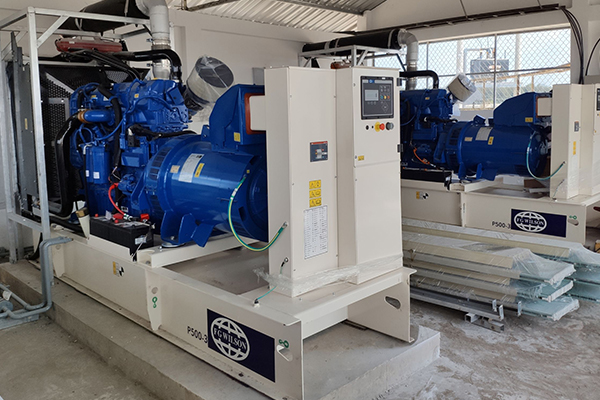
A 200-amp, 240 V single-phase service can draw up to 48 kW (200 A × 240 V). Because motor and HVAC loads run at about 0.8 power factor, most homes and businesses plan for roughly 60 kVA; a 200-amp 480 V three-phase service needs about 166 kVA. The exact size depends on your connected load, starting surge and future growth — this guide shows how to work it out.
Getting the size right keeps your diesel generator running reliably without overload or equipment damage. Below we cover the load calculation, how voltage and power factor change the required capacity, and the key factors to consider for a residential or commercial 200-amp service.
How many kW does a 200-amp service need?
A 200-amp service can supply up to 200 amps of current. The generator size in kilowatts (kW) or kilovolt-amps (kVA) depends on the system voltage and phase. See also our guide on how to calculate kVA for a generator.
- 240 V single-phase: Watts = Amps × Volts = 200 × 240 = 48,000 W = 48 kW. At a 0.8 power factor, that is 60 kVA.
- 480 V three-phase: kVA = (Amps × Volts × √3) ÷ 1,000 = (200 × 480 × 1.732) ÷ 1,000 ≈ 166 kVA.
These figures follow the standard load-calculation approach in the National Electrical Code (NEC / NFPA 70)1: start from the service amps, apply the voltage, then adjust for power factor to size the generator set2 correctly.
Step-by-step calculation for a 200-amp service
- Find the service wattage. Watts = Amps × Volts. For 200 A at 240 V: 200 × 240 = 48,000 W (48 kW).
- Apply the power factor. kVA = kW ÷ power factor. At 0.8 PF: 48 kW ÷ 0.8 = 60 kVA.
- For three-phase. kVA = (Amps × Volts × √3) ÷ 1,000. For 200 A at 480 V: (200 × 480 × 1.732) ÷ 1,000 ≈ 166 kVA.
How do voltage and power factor change the size?
Both voltage and power factor change how much generator capacity a 200-amp service needs.
Impact of voltage
Higher-voltage systems deliver the same power at lower current. A 240 V single-phase service needs a larger generator for the same load, while a 480 V three-phase service spreads the load across three phases and sizes more efficiently.
Impact of power factor
Power factor (PF) measures how efficiently power is used. Inductive loads (motors, HVAC, compressors) typically run around 0.8 PF, so the generator must be sized at 1.25× the real power (1 ÷ 0.8 = 1.25). Resistive loads (heaters, lighting) run near 1.0 PF and need less apparent power.
Generator size reference (by service and phase)
| Service | Voltage / Phase | Power Factor | Generator Size |
|---|---|---|---|
| 100-amp service | 240 V single-phase | 0.8 | 30 kVA (24 kW) |
| 200-amp service | 240 V single-phase | 1.0 | 48 kVA (48 kW) |
| 200-amp service | 240 V single-phase | 0.8 | 60 kVA (48 kW) |
| 200-amp service | 480 V three-phase | 0.8 | 166 kVA |
| 300-amp service | 240 V single-phase | 0.8 | 90 kVA (72 kW) |
Note: 100 A × 240 V = 24 kW; 300 A × 240 V = 72 kW (90 kVA at 0.8 PF).
Key factors when choosing a 200-amp generator
Several factors determine the right unit for a 200-amp residential or commercial service.

- Load type. Resistive loads (lighting, heating) size close to the wattage; inductive loads (motors, HVAC, compressors) need extra capacity for inrush current.
- Voltage and phase. Single-phase (typical residential) needs a larger unit than three-phase (commercial/industrial) for the same load. Match the generator to the service voltage and phase.
- Power factor. Size for about 0.8 PF when large motors or air conditioning are present; a higher PF lets you use a smaller unit.
- Starting surge. Motors and HVAC draw a large inrush current at startup. Size for surge, or add soft starters / VFDs to reduce it.
- Fuel type. Diesel generators are more efficient and durable for continuous heavy loads; gas units cost less upfront but suit lighter or intermittent duty. For a quieter option, see our silent diesel generators.
- Future growth. Add a 25% buffer above the estimated peak load to allow for future expansion.
For standby and emergency applications, follow the NFPA 110 standard for emergency and standby power systems3. If you are sizing a smaller service, check what size generator you need for a 32-amp supply or our explanation of what load on a diesel generator means.
Frequently Asked Questions
How many kW do I need for a 200-amp service?
A 200-amp, 240 V single-phase service can draw up to 48 kW (200 A × 240 V). Allowing for a 0.8 power factor, plan for about 60 kVA. A 480 V three-phase 200-amp service needs about 166 kVA.
What size generator do I need for a 200-amp service?
Most homes and small businesses use a 48–60 kW (60 kVA) generator for a 240 V single-phase 200-amp service. Choose the higher end if you have large motors, air conditioning, or heavy starting loads.
What size standby generator for a 200-amp service?
For standby duty, plan for 60 kVA (48 kW) at 0.8 power factor, plus margin for starting surge — typically a 50–60 kW standby generator covers a 200-amp home or business. Sizing for standby also follows NFPA 110.
What size generator do I need for a 300-amp service?
A 300-amp, 240 V single-phase service is about 72 kW (90 kVA at 0.8 PF). A 300-amp 480 V three-phase service is roughly 250 kVA.
How many kW can a 200-amp service handle?
A 200-amp, 240 V service can handle up to 48 kW continuously (200 × 240 = 48,000 W). At 120 V per leg, this is the same 200 amps per leg.
Can a diesel generator run a 200-amp service?
Yes. A diesel generator in the 50–60 kW range will run a 200-amp service, and diesel is especially good for continuous or heavy loads because of its efficiency and durability.
Conclusion
For a 200-amp service, you typically need a 60 kVA generator for a 240 V single-phase system (48 kW at 0.8 power factor) and about 166 kVA for a 480 V three-phase system. Size for your actual load, starting surge and future growth, and you will get reliable, long-lasting backup power. For a full generator comparison, see our diesel generator sets or the guide on calculating how many kVA you need.
-
NEC (NFPA 70) Article 220 defines branch-circuit, feeder and service load calculations used to size electrical services and generators. ↩
-
ISO 8528 (Part 5) specifies rating definitions and performance for reciprocating-engine-driven alternating-current generator sets. ↩
-
NFPA 110 is the standard for emergency and standby power systems, covering sizing, installation and testing. ↩