
Factory-Direct · ISO 8528-5 · Full-Load Tested
How We Build
Diesel Generators
Every generator is fabricated, assembled, and full-load tested inside our own factory in China. No subcontracting, no trading-company middlemen — one factory, one warranty, one team.
A Factory, Not a Trading Company
Many generator "manufacturers" in China are trading companies — they buy finished units from a factory, add their logo, and resell. When something goes wrong, they call the same factory for support, and you wait.
H&C owns the production floor. We employ the fabricators who cut the steel, the technicians who wire the control panels, and the engineers who sign the test reports. When you call for support, you speak to the people who built your generator — not a middleman.
Jiangsu, China — visitors welcome.
Equipment in Production
From Steel Sheet to Tested Set
Nine production machines, all on our floor — not a subcontractor's. Here is where each one sits in the build, and what it means for the generator you receive.
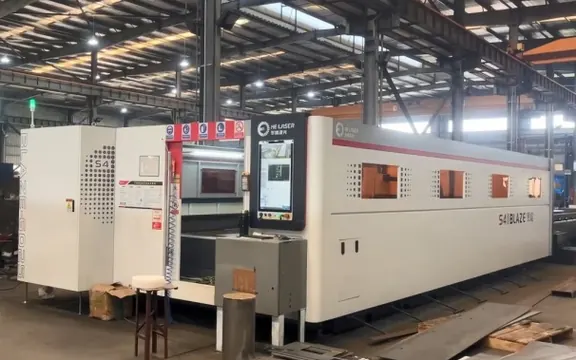
Cutting & forming · sheet cutting
Laser Cutting
Cuts base-frame members, enclosure panels and mounting brackets from steel plate up to 1500×6000mm and 20mm thick. Parts fit at assembly — no gaps, no rework.
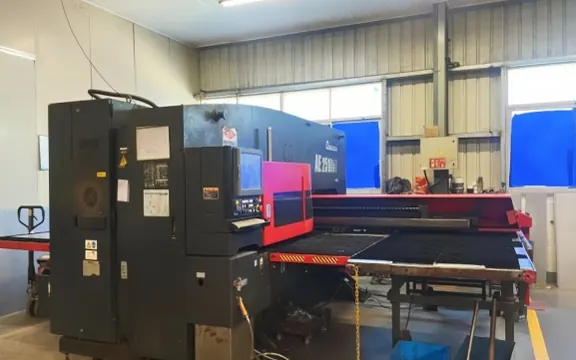
Cutting & forming · punching
CNC Turret Punch
Punches ventilation louvers, cable entries and mounting holes in a single pass. Burr-free edges go straight to powder coating — no hand-filing, no trapped swarf.
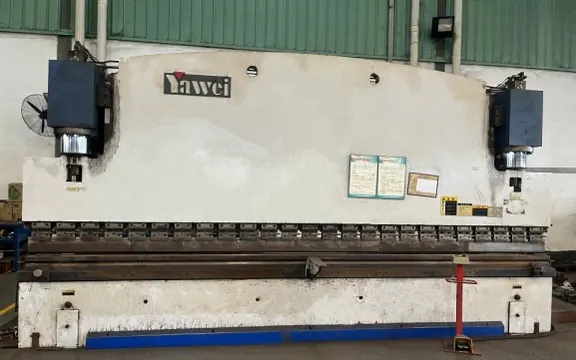
Cutting & forming · bending
CNC Press Brake
Forms enclosure panels, doors and structural members up to 4100mm long and 10mm thick. Programmable tooling keeps panel 1 and panel 200 identical.
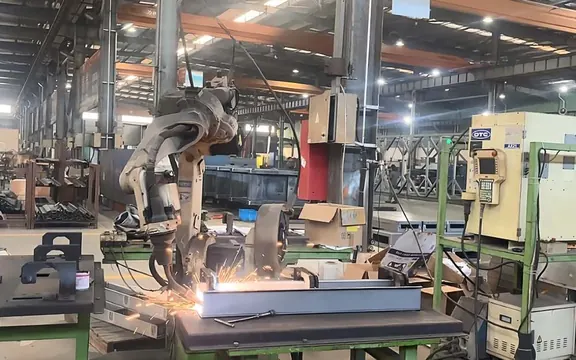
Welding · base frames & tanks
Robotic Welding System
Welds base frames and fuel tanks on a 6-axis, 6kg, 1445mm-reach robot with ±0.05mm repeatability. Uniform penetration is verified afterwards by the tank's airtightness test.
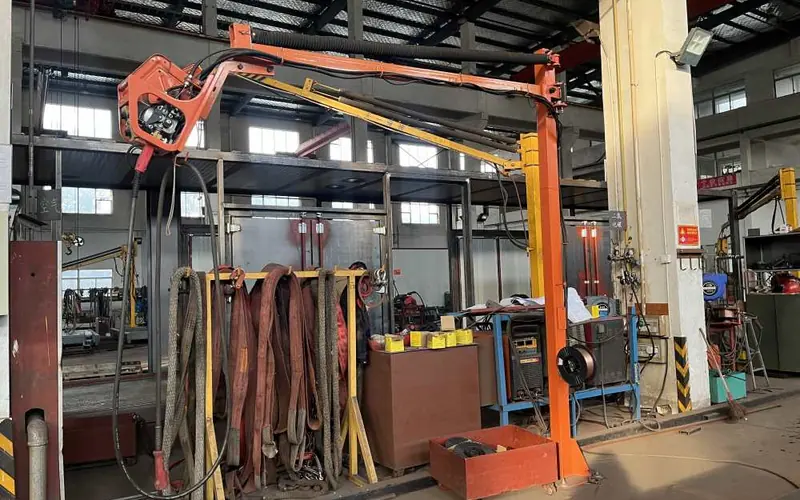
Welding · finishing & repair
Handheld Laser Welding
Finishes seams and repairs welds with minimal heat distortion. It reaches the joints the robot arm cannot.
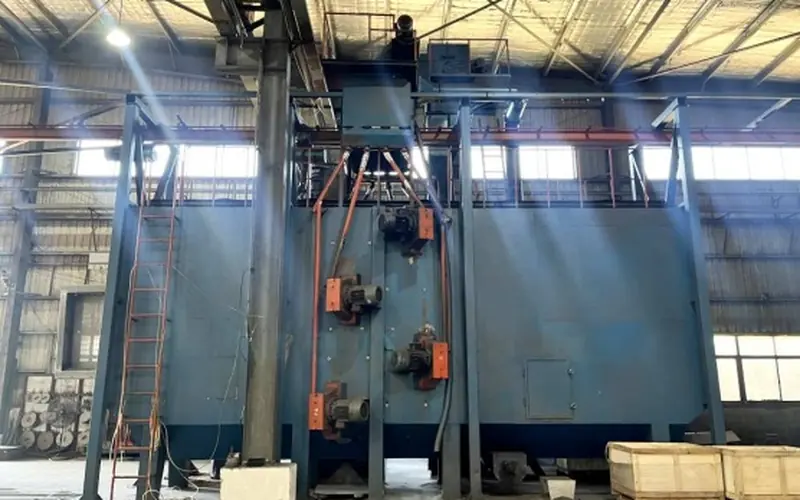
Surface treatment · blasting
Sand Blasting Machine
Removes mill scale and rust from fabricated steel before coating. The coating then bonds to clean metal, not to oxide.
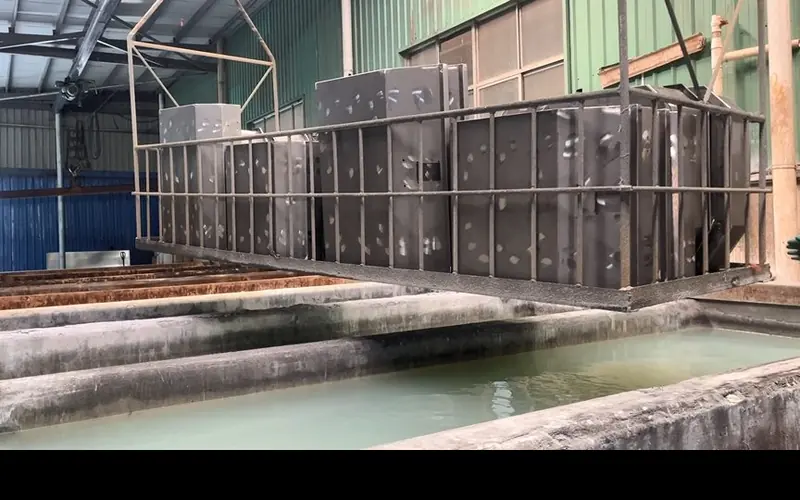
Surface treatment · pre-treatment
Pickling & Phosphating Pool
Pre-treats steel before coating. The powder coat bonds to the metal instead of sitting on top of it.
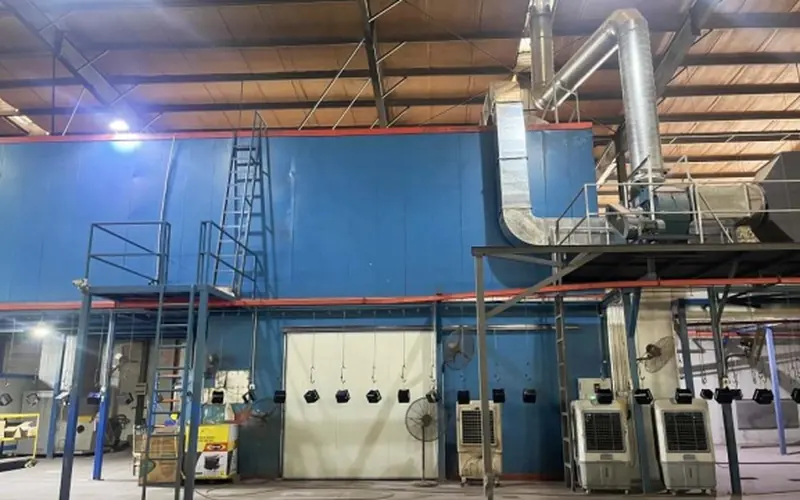
Surface treatment · coating
Powder Coating Line
Coats and cures canopies, cabinets and base frames. Coating thickness is measured with a gauge on every batch.
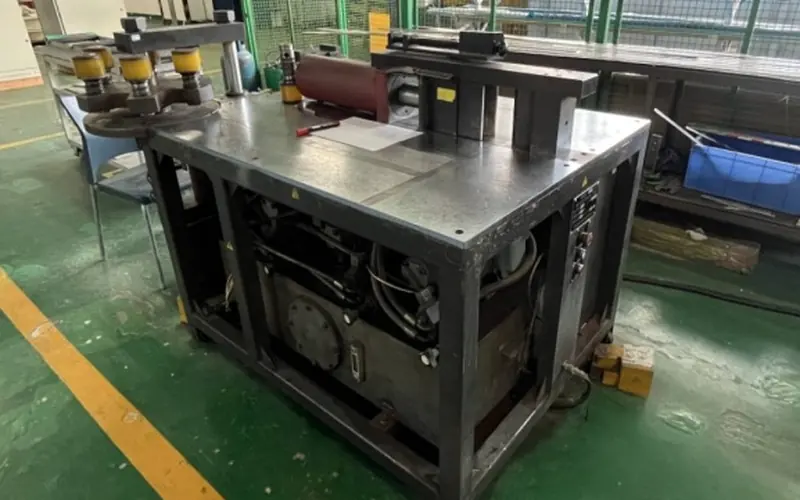
Electrical · control panels
Busbar Cutting Machine
Cuts and bends the copper busbars that carry power inside the control panel. Correctly sized busbars keep terminals cool under load.
The Build Process
From Raw Steel to Tested Power
Six stages, one factory. Every order starts with a technical review — site altitude, ambient temperature, load profile — before any steel is cut.
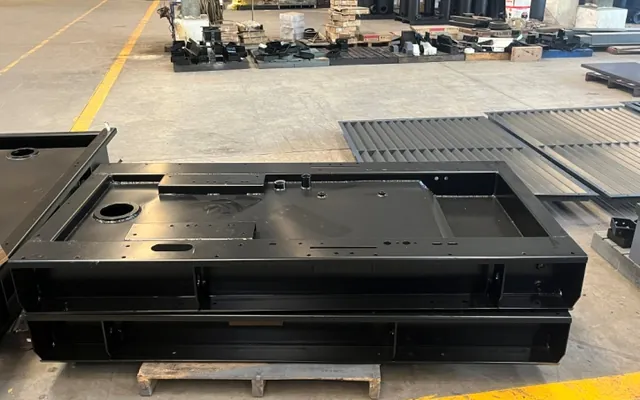
Step 1 of 6
Base Frame & Fuel Tank
Steel plate is cut, formed and robot-welded into the base frame and the fuel tank. The tank is then shot-blasted, primed, top-coated in black and pressure-tested for leaks before anything is mounted on it.
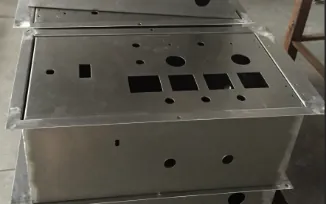
Step 2 of 6
Canopy & Control Cabinet
In parallel with the base frame, the canopy and the control cabinet are fabricated: sheet steel cut, punched, bent and welded into the enclosure and the cabinet shell.
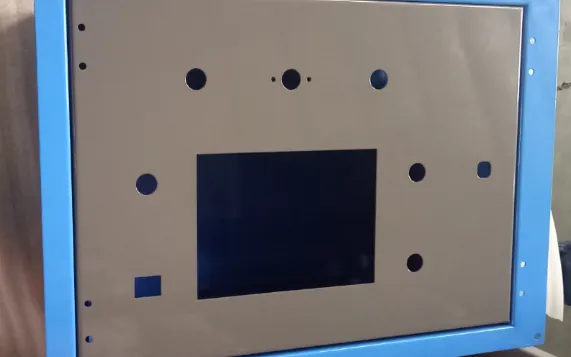
Step 3 of 6
Powder Coating & Insulation
Canopy and cabinet shells go through the powder-coating line. Coating thickness is measured, then the acoustic insulation is cut to size and fitted inside.
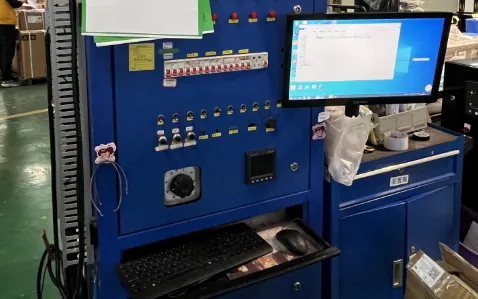
Step 4 of 6
Control Cabinet Wiring & Test
The main breaker, copper busbars, secondary circuits and the controller — DeepSea, ComAp or SmartGen — are mounted and wired. The finished cabinet is then tested as a whole before it goes anywhere near the set.
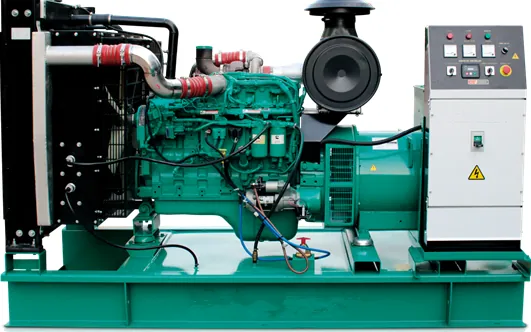
Step 5 of 6
Whole Machine Installation
Engine and alternator are mounted on the base frame, aligned and coupled; radiator, exhaust and the tested control cabinet are installed, and critical fasteners are torque-checked.
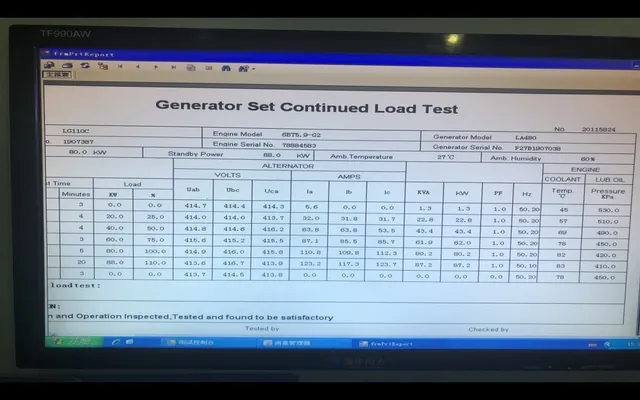
Step 6 of 6
Load Test
The finished set is stepped through 0%, 25%, 50%, 75% and 100% of rated kW and then held at 110% overload on our resistive load bank. Nothing ships until the readings are logged and the report is signed.
In-Process Inspection
Quality Gates Inside the Build
Quality is checked inside the process, not bolted on at the end. Four gates decide whether a set moves on — each one is measured, recorded and signed off, and the results travel with your generator.
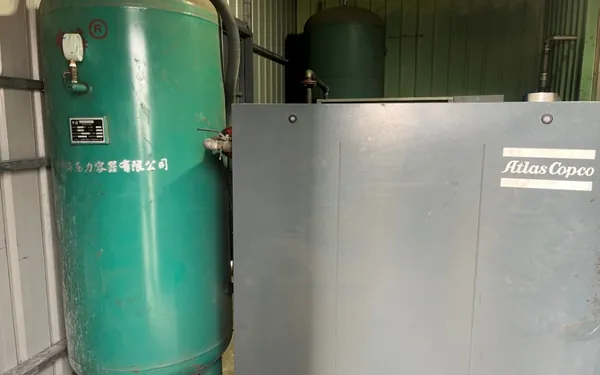
Step 1 · fuel tank
Tank Airtightness Test
Every weld seam on the base tank is checked under pressure before the tank is built into the set. A leaking tank never reaches assembly — you never inherit a fuel stain you cannot trace.
Step 3 · powder coating
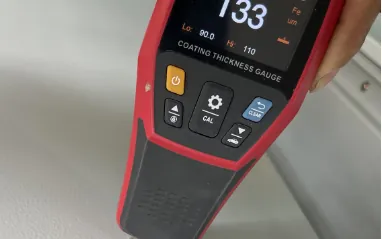
Coating Thickness Check
Coating thickness is measured on canopies and cabinets after every batch, and the reading goes on the batch record. Thin coating rusts from the inside out, where you cannot see it.
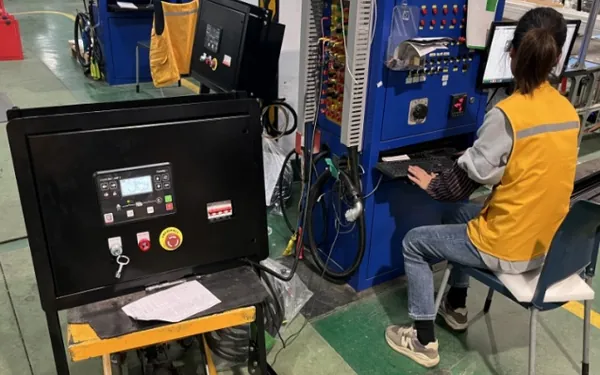
Step 4 · control cabinet
Control Cabinet Full Test
The finished cabinet is tested as a whole: module status, protection functions, live electrical checks and parameter verification. Your panel is proven on our bench, not first energised on your site.
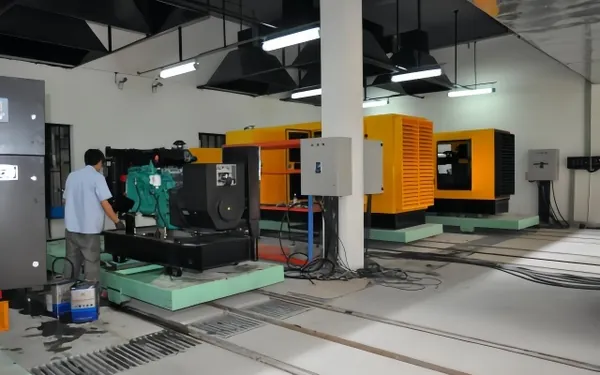
Step 6 · load test
Full-Load Test · 3.6MW
600kW × 4 plus 1200kW × 1 — 3.6MW of resistive load capacity, enough for every set we build. Each one is stepped to rated load and held at 110% overload; the readings go into the signed test report.
Factory Testing
Tested Before You Pay — Not a Promise, Proof
Nothing leaves the factory on a promise. Every set is run at full load, the readings are recorded, and the report is signed — and you are welcome to watch.
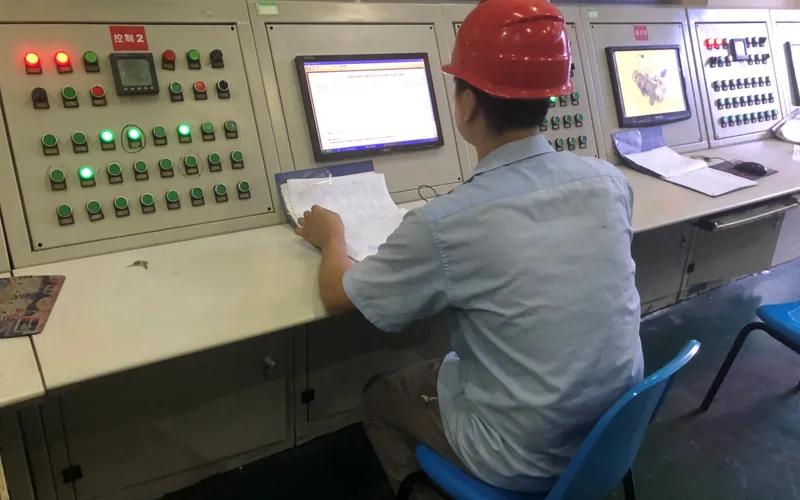
Every Generator. Full Load. No Exceptions.
Before shipment, every generator is stepped from 0% to 100% of rated kW, and then held at 110% overload. This is not a spot check or a sample test: it is every unit, every time, per ISO 8528-5.
We log and verify: steady-state voltage regulation (±1%), frequency stability (±0.5%), engine coolant and oil temperatures under sustained load, transient voltage and frequency response under block load steps, and automatic safety shutdown functions. A signed test report is included in your delivery documentation.
Tested to ISO 8528 (Parts 1–12) and IEC 60034-1 / IEC 60034-22 for the alternator, ISO 3046-1 for engine performance and IEC 62271-200 for the switchgear — with FAT / SAT support when your project requires witnessed acceptance.
Load Acceptance & Load Rejection
Load is thrown on and off in blocks while the set is running — the way it happens on site when a transfer switch closes or a large motor starts. We record the transient voltage dip, the frequency deviation and the time to recover, per ISO 8528-5, so you know the set carries your load — not just a steady-state one.
Protection Settings & Shutdown Test
Overspeed, low oil pressure, high coolant temperature, voltage and frequency limits, fail-to-start and emergency stop are all setpoints inside the controller — set to the engine maker's limits and your project's values. Each one is then triggered on the running set and the shutdown confirmed, and the setpoints used are recorded in your test report.
FAT & SAT Support
FAT and SAT are acceptance milestones you have to clear with your client — and we have supported EPC contractors through them. Send us your consultant's test procedure and document list; we will have the set, the test bay and the paperwork ready for the agreed date. Your inspector can witness the test at our works, or our engineers can support acceptance on site — same documentation for signature either way.
Certifications & Documentation
Documented, Not Just Promised
ISO 8528-5 means every step is audited and traceable. When your EPC client asks for compliance evidence, you have it — material certs, weld records, test data. No scrambling, no delays.



What Ships With Every Generator
Support Beyond Delivery
After the Generator Leaves Our Floor
A diesel generator is a long-term power asset, not a commodity. Our support continues long after the generator ships.
Testing & Commissioning
On-site commissioning support ensures your generator starts correctly the first time. We provide remote guidance as standard; for qualifying projects, a factory engineer travels to your site to supervise commissioning and verify installation.
- ✓ Site installation verification
- ✓ Load bank commissioning test
- ✓ ATS & controller configuration
Installation Support
Installing a generator overseas means local codes, fuel system design, exhaust routing, and foundation requirements. We provide the technical documentation and remote support to get it done right — wherever your site is.
- ✓ Installation drawings & manuals
- ✓ Foundation & ventilation guidance
- ✓ Remote technical consultation
After-Sales & Spare Parts
Generators run for decades — and they need maintenance. We stock genuine spare parts for engines, alternators, and controllers, and ship worldwide. Technical support by phone, email, or WhatsApp, straight from the engineers who build your unit.
- ✓ Genuine spare parts — global shipping
- ✓ Technical support from our engineers
- ✓ Maintenance schedule & service kits
Frequently Asked Questions
Does H&C manufacture diesel generators in its own factory?
How is every generator tested before shipment?
What documentation comes with each generator?
Can I witness the test or visit the factory?
Visit Our Factory
Come and see your set built and tested before it ships.
Before shipment, inspect your generator at our factory in Jiangsu. Walk the production floor, meet the fabricators and engineers, witness the full-load test. We'll show you every step — no appointment needed to hide anything. What you see is what you get.