
Silent Diesel Generators
Soundproof diesel generator sets from 30kW to 2000kW, built on Cummins, Perkins, MTU or Mitsubishi engines — with the enclosure fabricated in our own factory in Jiangsu, China. Canopy sets hold ≤75 dB(A) at 7 m; hospital-grade builds go below 70 dB(A), and from 1000 kW the set ships in a container enclosure rated ≤85 dB(A) at 7 m. Factory-direct since 1983, exporting since 2003.
Since 1983 · ISO 8528-5 Certified · Full-Load Tested · 65–85 dB(A) enclosure grades
How Quiet Does It Need to Be?
Noise is usually a limit, not a preference — written into a planning condition, a consultant’s specification or a local ordinance. Work out which band your site falls into, then we build the enclosure to it.
Residential, night-time
Typical limit: apartments, villas and mixed-use sites where the set runs near bedrooms or a shared boundary. We build: the residential-grade enclosure, the quietest we make.
Hospitals & hotels
Typical limit: wards, guest rooms, clinics and offices where a set must start without being noticed. We build: the hospital-grade enclosure, below 70 dB(A) at 7 m.
Commercial & industrial daytime
Typical limit: offices, retail, workshops and construction sites inside normal working hours. We build: the standard soundproof canopy, used up to 800 kW.
Industrial & containerized
Typical limit: plants, mines and remote sites where the nearest neighbour is far away. We build: the 40 ft container enclosure, used from 1000 kW.
Two things decide the number you have to hit: the distance to the nearest sensitive receiver, and whether the set runs at night. In free field, sound falls by roughly 6 dB every time you double the distance — so 75 dB(A) at 7 m is about 69 dB(A) at 14 m; reflections, walls and barriers change the real figure on site. Our dB(A) figures are A-weighted sound pressure at 7 m.
Where the EU outdoor noise directive (2000/14/EC) applies, the limit is set by the set’s power band and declared as a guaranteed sound power level — marked on the machine and stated in the EC declaration of conformity. Tell us the market and we build and record to that limit. Send us your noise limit →
Want the physics behind those numbers? Why a generator can never be as quiet as a car engine →
Already have a noise assessment or a planning condition? Most projects arrive with a figure already written down — a limit at the nearest dwelling, a condition attached to the permit, or an assessment against the existing background noise. Send us that figure and the measurement distance, and we will tell you which enclosure grade meets it before you place an order. If the limit is tighter than our standard canopy can hold, we will say so rather than quoting around it. Send us your assessment →
How We Make a Generator Quiet
Silence is enclosure engineering, not an engine label. Six things decide the result — and we do all six in our own factory.
Built in our own workshop, configured to your site
The canopy is fabricated in our own workshop — sheet metal, surface preparation, coating and assembly — not bought in and adapted. For project work we configure the build to your site: control panel position, cable entry direction, and which faces open for service.
Acoustic lining — non-combustible, and chosen for the target
Sound is absorbed by the lining and the perforated steel that holds it, so thickness, density and facing decide how much is absorbed. The lining is non-combustible, and the build is selected against your decibel target rather than one standard sheet — an enclosure has to stay safe when a set runs hot for hours.
A silencer matched to the engine, not a universal can
Exhaust is the low-frequency part of the noise, and the part a canopy alone cannot absorb. The silencer is selected for the attenuation your site needs and stays inside the engine maker\'s backpressure limit, so the set keeps its rating and stays within the engine\'s requirements.
Air paths that attenuate without starving the radiator
The air inlet and outlet are the largest openings in any enclosure and the usual weak point. They are baffled so the air turns while the sound is absorbed, and sized against the radiator\'s airflow for the ambient temperature at your site, so the set still carries full load.
Weatherproof — to the corrosion class your site needs
The shell is steel, blasted and phosphated before coating, and the protection system is selected to the corrosivity of the environment: C1 to C5 under ISO 12944, from a dry plant room to a coastal or heavily polluted site. Tell us where the set will stand and we build the canopy to that class.
Tested before shipment, documented for handover
Every set is stepped to rated load and held at 110% overload before it ships, with protection settings triggered and a signed test report. Documentation includes the engine and alternator certificates, control module test record, wiring schematic, installation and maintenance manual, and the supply and loose-part lists.
Built and Finished in Our Own Shop
Shell, lining, coating and assembly are all in-house — including our own blasting, phosphating and powder coating line — so the enclosure is built around the set and around your noise limit, not bought in.
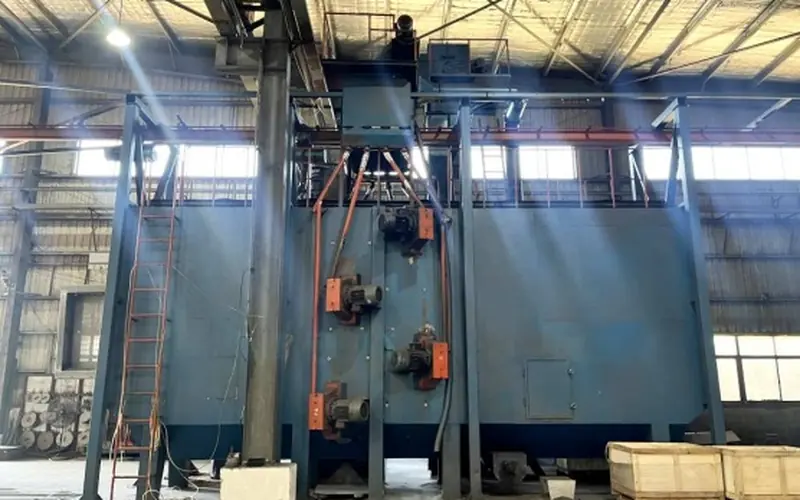
Sand blasting machine — surface preparation before coating
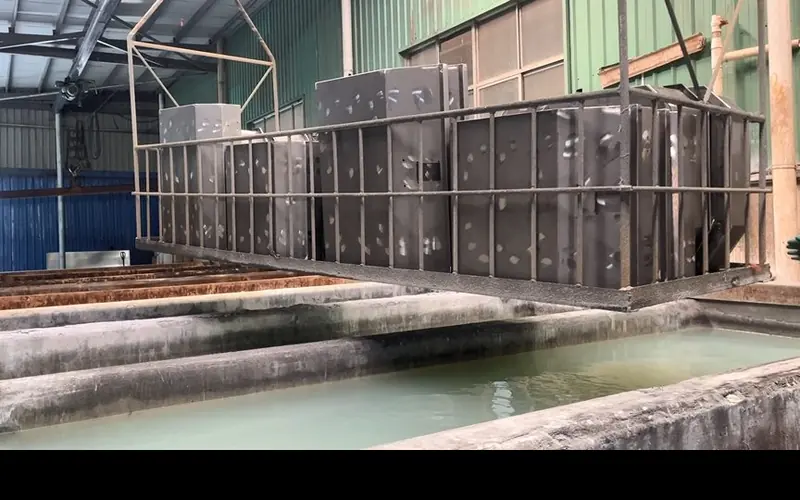
Pickling and phosphating pool — steel parts before coating
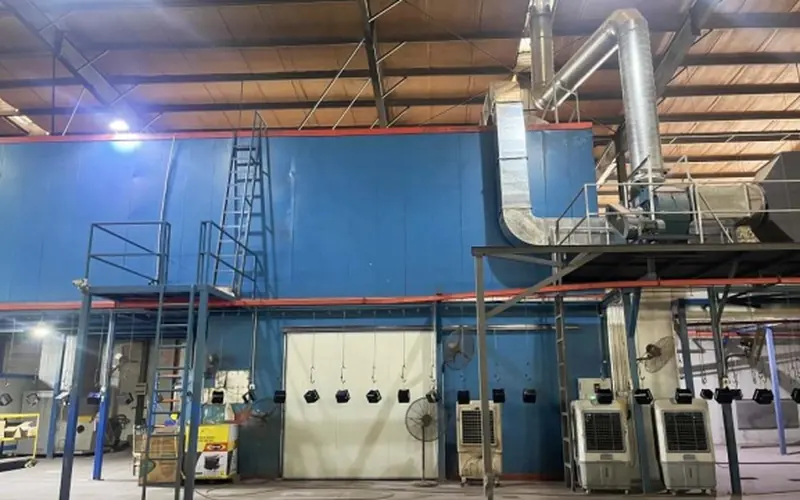
Powder coating line — parts travel through the booth
Silent vs Open vs Container
The engine and alternator can be identical — the enclosure decides the noise, the footprint and the price.
| Open (skid) | Silent / soundproof | Containerized | |
|---|---|---|---|
| Sound level at 7 m | Typically 95 dB(A) or more at 7 m — too loud for most sites | 65–75 dB(A) — about 10–15 dB(A) below the same set open | 75–85 dB(A) at 7 m, engineered per site |
| Noise treatment | Needs a plant room or an acoustic barrier built around it | Delivered as a finished acoustic enclosure — nothing to build | Delivered as a complete container enclosure — nothing to build |
| Cost | Lowest — no enclosure | + enclosure, lining and silencer | + ISO container and site works |
| Footprint | Smallest | Larger: 1.3–1.5× the open set (40 ft container above 1000 kW) | Largest: 20ft or 40ft ISO |
| Installation | Needs a plant room or acoustic barrier | Drop on a slab, connect, run | Drop on prepared ground, connect services |
| Maintenance access | Unrestricted | Doors and removable panels | Doors and side access |
| Typical use | Remote sites, plant rooms with barriers | Hospitals, hotels, offices, residential, telecom | Plants, mines, rental fleets, harsh environments |
Every Rating Is Available Silent
A silent set is not a separate machine. Any rating from 30 kW to 2000 kW can be supplied in a soundproof canopy (model suffix /S) — or in a 40 ft container enclosure above 1000 kW.
Choose your rating on the full range
Power 30–2000 kW · Cummins, Perkins, MTU or Mitsubishi · open skid, soundproof canopy or container. Every model page carries its own dimensions, weight and noise data, so ratings can be compared in one place.
Open the full generator set range →Every set is load-tested to 110% overload before shipment and ships with a signed ISO 8528-5 test report — see how the sets are built and tested →
Need a tighter number? The 70 dB(A) hospital-grade and 65 dB(A) residential-grade enclosures are built to order on the same models — send us the limit and the distance →
Frequently Asked Questions
How quiet is a silent diesel generator?
What is inside the soundproof canopy?
Does the canopy affect cooling or service access?
Can the canopy be adapted to my site?
Can a silent generator run indoors or in a basement?
What is the difference between a silent canopy, hospital grade and a container enclosure?
How much more does a silent set cost than an open set?
How long does a silent set take to build?
Need a Silent Generator Quote?
Send your power rating, the noise limit and the distance to the nearest neighbour — we will confirm the enclosure grade and price within 24 hours.
Request a Quote →