
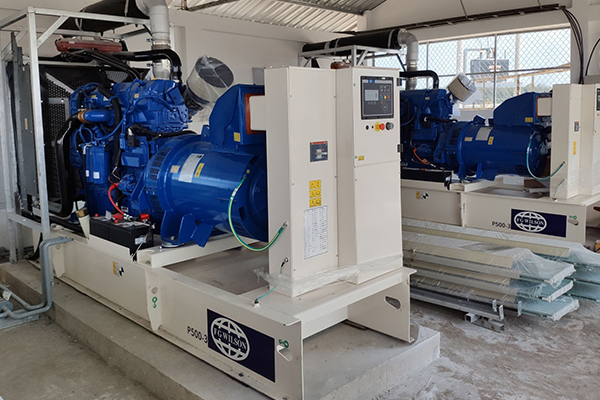
A 30 kW generator1 can power a wide range of appliances and equipment, but its capacity depends on the type of load, startup requirements, and the efficiency of the devices connected. Understanding these factors helps ensure that your generator operates efficiently without overloading.
A 30 kW generator can typically power small businesses, homes, and essential equipment in medium-sized facilities, but careful load management is essential.
Let’s explore what types of equipment can be powered by a 30 kW generator and the factors that influence its performance.
What types of appliances and equipment can a 30 kW generator power?
A 30 kW generator can handle both residential and commercial loads, powering devices like air conditioners, servers, and motors. However, simply adding up the wattage is not enough. The total current (amps), influenced by your specific voltage and phase, is the true core factor in determining your generator’s capacity.

Typical appliances powered by a 30 kW generator
Here is a detailed 30 kW generator load capacity breakdown showcasing what standard residential and commercial equipment you can run:
| Equipment/Appliance | Power Consumption (kW) | Quantity Powered by a 30 kW Generator |
|---|---|---|
| LED Lighting | 0.01–0.02 kW per bulb | Up to 1500 bulbs |
| Desktop Computers | 0.2 kW each | Up to 150 units |
| Air Conditioner (Split Unit) | 2–3 kW each | Up to 10 units |
| Refrigerators | 0.5–1.5 kW each | Up to 20 units |
| Washing Machines | 1–2 kW each | Up to 15 units |
| Microwave Oven | 1.5 kW each | Up to 10 units |
| Small Pumps | 1–2 kW each | Up to 15 pumps |
The Core Factor: Total Current (Amps) vs. Simple kW Addition
While the table above provides a basic guideline based on power (kW), calculating whether a generator can actually handle your load requires a deeper look. Simply adding up the wattage (kW) of all your devices does not equal the actual load burden on the generator set.
The core factor in determining whether a generator can support your equipment is the total current (measured in Amps). Residential equipment and industrial machinery operate on entirely different voltages and phases, which completely changes the current calculation formula:
- Residential Use (Typically Single-Phase, 120V/240V): The current calculation is relatively straightforward.
- Industrial/Commercial Use (Typically Three-Phase, 208V/480V): Three-phase power distribution is much more complex, and the current formula must account for the square root of 3 (1.732) and the specific power factor.
Because of these electrical differences, a 30 kW generator outputting three-phase power will have a completely different maximum amp rating per phase compared to a single-phase setup.
Why Load Balancing Matters
Once the correct capacity is calculated, managing how that power is used is equally important. Distributing power demands evenly across different devices and systems ensures that the generator can run smoothly and prevent overloading.
- For Home Usage: Make sure to prioritize essential equipment (e.g., HVAC, lighting) and avoid running multiple heavy-load devices simultaneously.
- For Industrial Usage: Ensuring that the load is evenly distributed across all three phases (Phase Balancing) is critical to prevent damaging the generator’s alternator.
💡 Need Help Calculating Your Actual Load?
Since voltage, phase, total current, and load balancing make generator sizing far more complex than simple addition, you shouldn’t guess. Contact our expert engineering team today. We will accurately calculate your total current draw based on your specific residential or industrial equipment and recommend the perfect, most reliable generator for your needs.
How does load type (resistive vs inductive) affect a 30 kW generator?
Inductive loads, such as motors and air conditioners, require significantly more generator capacity than resistive loads. This is because they have a lower power factor2 and demand a massive surge of starting power (inrush current), which effectively reduces the generator’s available output compared to simple resistive equipment.

- Resistive loads (e.g., lighting, heating elements) consume power directly and typically have a power factor close to 1.0.
- Inductive loads (e.g., motors, air conditioners, pumps) create magnetic fields and have a lower power factor, often around 0.7 to 0.9.
Understanding the exact type of your equipment—resistive or inductive—is critical when sizing a generator, as it directly affects both the power factor2 and the generator’s ability to handle the load without stalling.
Key Differences Between Resistive and Inductive Loads:
To help you calculate your true power demands, here is a detailed comparison of resistive vs. inductive loads and their impact on your 30 kW generator capacity:
| Load Type | Power Factor | Impact on Generator | Examples |
|---|---|---|---|
| Resistive | 1.0 | More efficient, no need for additional capacity for power factor | Lighting, electric heaters |
| Inductive | 0.7–0.9 | Requires more generator capacity to handle reactive power | Motors, air conditioners, refrigerators |
Impact on Generator Sizing and Starting Power
- Resistive loads consume power directly and are highly efficient. A 30 kW generator can handle resistive loads much closer to its full 30 kW capacity.
- Inductive loads create magnetic fields to operate, which requires extra power to overcome reactance. More importantly, they require a massive surge of power just to start up.
For example, a standard 1 HP motor (an inductive load) might only need 1.2 kW of power to keep running, but it can require 1.5 kW to 3.5 kW or more just to start, depending on the specific inrush current.
Practical Example:
If your 30 kW generator powers 10 air conditioners, each consuming 2.5 kW while running, the total running load appears to be 25 kW. However, because these are inductive loads3(https://avtronpower.com/resources/articles/resistive-inductive-and-capacitive-load-banks/), the actual power and current needed to start them simultaneously would far exceed 30 kW. To manage this, you must properly size the generator or use load balancing to start the units one by one.
What is the difference between a 30 kW and 30 kVA generator?
The difference lies in the power factor. kW (kilowatts) measures the actual real power the generator produces to do useful work. In contrast, kVA (kilovolt-amperes) measures the apparent power, which includes both the working power and the extra reactive power needed to start and run inductive loads.
Many buyers confuse kW and kVA when sizing their equipment, which can lead to purchasing an undersized generator. Understanding the math behind the power factor (PF) is essential to avoid this costly mistake.
How Power Factor Affects kW and kVA
The relationship between kW and kVA is defined by the generator’s power factor, which represents how efficiently the generator supplies power. For most industrial diesel generators, the standard power factor is 0.8.
- kW (Real Power) = kVA × Power Factor
- kVA (Apparent Power) = kW / Power Factor
The 30 kW vs. 30 kVA Reality Check:
- If you buy a 30 kVA generator (with a 0.8 PF), its actual real power output is strictly limited to 24 kW (30 x 0.8 = 24).
- Conversely, if your equipment specifically requires 30 kW of real power to run, and involves inductive loads (like heavy motors), you will actually need to purchase a 37.5 kVA generator (30 / 0.8 = 37.5) to safely handle the load.
Generator Efficiency and Effective Output
Even if you properly calculate the kVA and power factor, generator efficiency also plays a crucial role. Most diesel and gas-powered generators are designed to operate at 80–90% efficiency to prevent overheating and extreme engine wear.
Therefore, a true 30 kW generator operating at a safe, continuous load will effectively provide about 24 kW to 27 kW of usable power. Pushing any generator to 100% of its rated capacity continuously is highly discouraged and will dramatically shorten its lifespan.
Frequently Asked Questions (FAQs)
How many amps does a 30 kW generator produce?
A 30 kW generator typically produces about 125 amps when operating on a standard residential single-phase 240V system. For industrial three-phase 480V systems, it produces approximately 45 amps per phase. The exact amperage depends heavily on your specific voltage, phase, and power factor.
What is the fuel consumption of a 30 kW diesel generator?
At a 50% load, a standard 30 kW diesel generator consumes approximately 1.5 to 1.8 gallons of diesel fuel per hour. Fuel consumption will increase or decrease depending on the actual electrical load you are drawing and the specific efficiency of the generator’s engine.
How many AC units can run on a 30 kVA generator?
A 30 kVA generator can comfortably run one large central air conditioning system or up to 10 split-unit ACs, provided they are not started simultaneously. Because air conditioners are inductive loads with high inrush currents, using load balancing to stagger their startup is highly recommended to prevent overloads.
How much does a 30 kW generator cost?
The price of a 30 kW generator varies significantly based on its specific configuration, such as whether you need a silent canopy enclosure, single-phase or three-phase output, and an automatic transfer switch (ATS). For the most accurate and cost-effective pricing tailored to your exact power needs, please contact our expert engineering team for a custom quote.
Do I need a single-phase or 3-phase 30 kW generator?
If you are using the generator for whole-house residential backup power, you will need a single-phase 30 kW generator. Conversely, if you are powering a factory, large commercial facility, or heavy-duty industrial motors, a 3-phase generator is strictly required.
Conclusion
A 30 kW generator provides robust and reliable power for mid-to-large whole houses and essential commercial equipment. However, simply knowing the wattage is never enough. To ensure stable and reliable operation, you must factor in the exact load type (resistive vs. inductive), calculate the total current based on your voltage phase, and understand the critical difference between kW and kVA. By carefully managing your load and properly sizing for peak inrush currents, your 30 kW generator will deliver optimal efficiency without the risk of overloading
-
Explore this link to understand the full range of appliances and equipment a 30 kW generator can support, ensuring you make informed decisions for your power needs. ↩
-
Discover the significance of power factor in generator efficiency and how it influences your power supply decisions for optimal performance. ↩ ↩
-
Learn about inductive loads and their impact on generator performance, which is crucial for effective power management and equipment operation. ↩